India Textile and Fabric Statistics 2026: Market Size, Exports, Weddings and Fabric Demand
- By Fabcouture
Looking for reliable numbers on the Indian fabric and clothing market? This page collects 80 statistics on India's textile industry, exports, cotton, silk and wool, handloom, fashion retail, wedding and festive spending and online shopping. Every statistic comes with the year it applies to and a link to its source, so you can check it yourself. Where research firms disagree, we show both figures. If you are exploring fabrics for a project, these numbers explain what is driving the market. Start with the infographic below for the big picture, then scroll down for every statistic and its source.
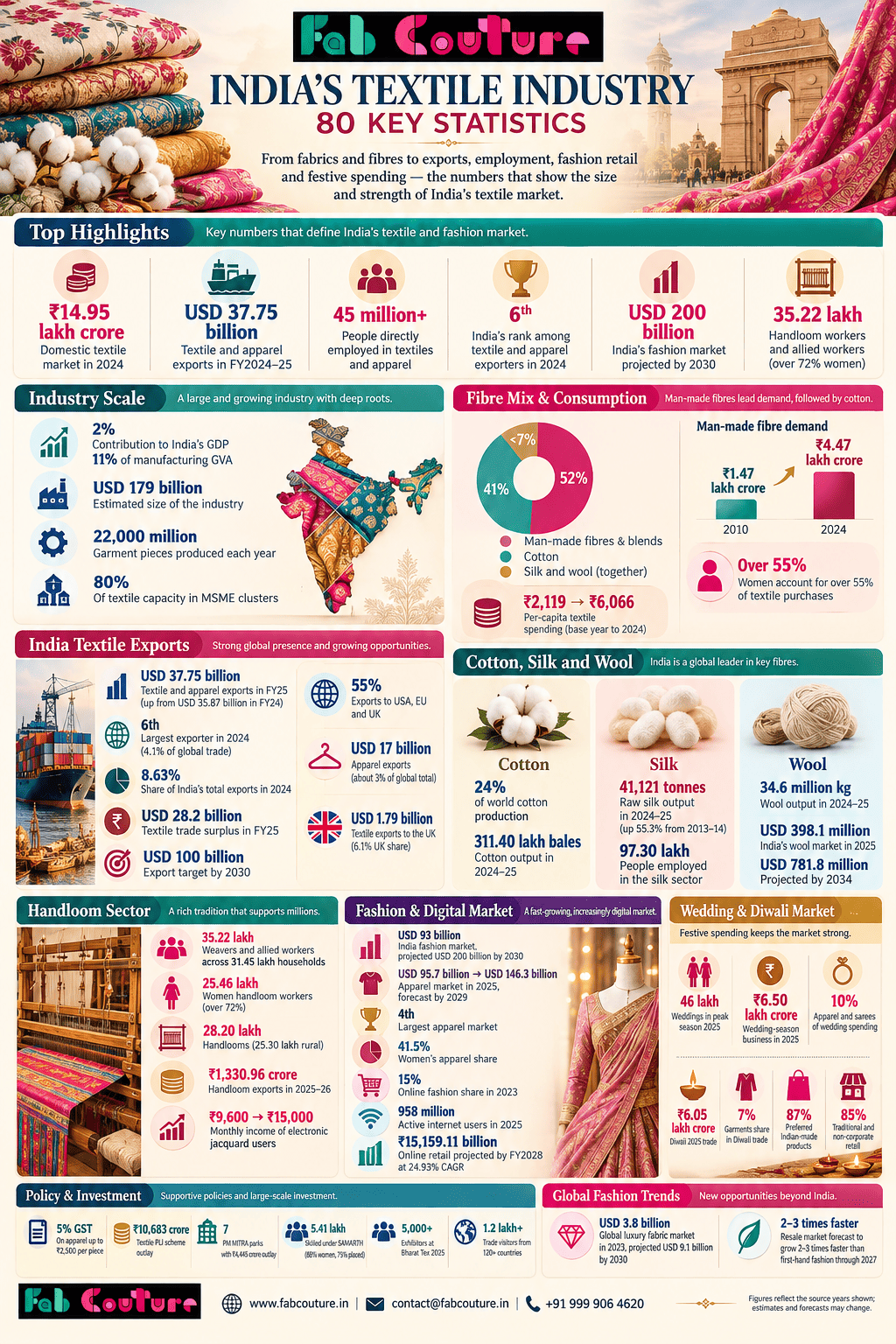
Key India Textile and Fashion Statistics at a Glance
- ₹14.95 lakh crore: India's domestic textile market in 2024. (Source)
- USD 37.75 billion: textile and apparel exports in FY25. (Source)
- 6th: India's rank among textile and apparel exporters in 2024. (Source)
- 45 million+: people directly employed in textiles and apparel. (Source)
- 52%: share of man-made fibres and blends, against about 41% for cotton. (Source)
- 35.22 lakh: handloom weavers and allied workers, over 72% of them women. (Source)
- USD 200 billion: projected size of India's fashion market by 2030. (Source)
- 46 lakh: weddings in the 2025 peak season, worth about ₹6.50 lakh crore. (Source)
- ₹6.05 lakh crore: Diwali 2025 trade. (Source)
- 958 million: active internet users in India in 2025. (Source)
- 15%: online share of India's fashion market in 2023. (Source)
- 5% GST: on apparel up to ₹2,500 per piece. (Source)
India Textile Industry Statistics
Behind these numbers sits an enormous range of everyday cloth. If you stitch for family, a boutique or a label, our full range of fabrics is a good place to see how wide that range really is.
How much does the textile sector contribute to India's GDP?
Textiles contribute about 2% of India's GDP and about 11% of manufacturing gross value added.
Source:PIB / Ministry of Textiles document (Feb 2026) (Feb 2026 document)
How many people work in India's textile and apparel sector?
Over 45 million people are directly employed in textiles and apparel.
Source:PIB / Ministry of Textiles document (Feb 2026) (2025 estimate)
How big is the Indian textile industry?
The industry has an estimated size of about USD 179 billion.
Source:PIB / Ministry of Textiles document (Feb 2026) (Feb 2026 document)
How many garments does India produce each year?
India produces about 22,000 million garment pieces a year.
Source:PIB / Ministry of Textiles document (Apr 2025) (Annual)
How much of India's textile capacity sits in MSME clusters?
About 80% of India's textile capacity sits in MSME clusters.
Source:PIB / Ministry of Textiles document (Apr 2025) (Apr 2025 document)
Which ranks does India hold in global fibre production?
India is the largest cultivator of cotton by acreage and the second-largest producer of both cotton and silk.
Source:PIB / Ministry of Textiles document (Feb 2026) (2026 document)
Fabric and Clothing Demand Statistics
With man-made blends and cotton leading demand, budget-friendly basics are the natural starting point for most stitching projects. Plain cotton fabric and rayon fabric are good examples.
How much did Indian households and industry spend on textiles in 2024?
The domestic textile market reached ₹14.95 lakh crore in 2024, up from ₹4.89 lakh crore in 2010.
Source:Ministry of Textiles national household survey 2024, as reported by Textile Excellence (2024)
How much does the average Indian spend on textiles?
Per-capita textile spending rose from ₹2,119 to ₹6,066.
Source:Ministry of Textiles national household survey 2024, as reported by Textile Excellence (2024 vs base year)
Which fibres do Indians buy most?
Man-made fibres and blends make up over 52% of the market, cotton about 41%, and silk and wool together less than 7%.
Source:Ministry of Textiles national household survey 2024, as reported by Textile Excellence (2024)
How much has man-made fibre demand grown?
Man-made fibre demand rose from ₹1.47 lakh crore to ₹4.47 lakh crore.
Source:Ministry of Textiles national household survey 2024, as reported by Textile Excellence (2024 vs 2010)
Who buys most of India's textiles?
Women account for over 55% of textile purchases.
Source:Ministry of Textiles national household survey 2024, as reported by Textile Excellence (2024)
What share of household spending goes on clothing and footwear?
Clothing, bedding and footwear take 6.63% of monthly spending in rural India and 5.66% in urban India.
Source:MoSPI Household Consumption Expenditure Survey 2023-24 (Table 3.5) (2023-24)
What is the average monthly spending per person in India?
Monthly per-capita spending is ₹4,122 in rural India and ₹6,996 in urban India.
Source:MoSPI Household Consumption Expenditure Survey 2023-24 (2023-24)
India Textile Export Statistics
India's export story is also a story of scale and supply chains. Boutiques and designers who need larger quantities can ask FabCouture about bulk and wholesale discounts.
How much did India export in textiles and apparel in 2024-25?
Textile and apparel exports, including handicrafts, reached USD 37.75 billion in FY25, up from USD 35.87 billion in FY24.
Source:PIB / Ministry of Textiles document (Feb 2026) (FY25)
Where does India rank among textile and apparel exporters?
India was the sixth-largest textile and apparel exporter in 2024, with 4.1% of global trade.
Source:Ministry of Textiles Year End Review 2025 (2024)
How important are textiles to India's total exports?
Textiles and apparel made up 8.63% of India's total exports in 2024.
Source:Ministry of Textiles Year End Review 2025 (2024)
What is India's trade surplus in textiles and apparel?
India ran a textile and apparel trade surplus of USD 28.2 billion in 2024-25.
Source:Ministry of Textiles Year End Review 2025 (2024-25)
What is India's textile export target for 2030?
The government's Vision 2030 target is USD 100 billion in textile and apparel exports.
Source:Ministry of Textiles Year End Review 2025 (2030 target)
Which markets buy the most Indian textiles?
The USA, EU and UK together took 55% of India's textile and apparel exports, while emerging markets took 20%.
Source:Ministry of Textiles Year End Review 2025 (2024-25)
How much of the world's apparel exports does India supply?
India exported about USD 17 billion of apparel, around 3% of the global total.
Source:WTO World Trade Statistics 2025, as reported by Modaes (2024)
How far ahead is China in apparel exports?
China exported USD 157 billion of apparel, a 27.3% global share, while the EU exported USD 177 billion (30.8%).
Source:WTO World Trade Statistics 2025, as reported by Modaes (2024)
How much of India's textile exports does the EU buy?
India exports around USD 7.7 billion of textiles and apparel to the EU, about 20% of its total textile exports.
Source:Kotak Neo, citing market data (2026 report)
How big is the EU textile import market?
The EU imports over USD 125 billion of textiles and apparel a year, with India holding five to six percent and China about 30 percent.
Source:Jefferies note, as reported by FashionUnited (2026)
What did the India-UK trade deal change for textiles?
Duties on 1,143 textile tariff lines were removed, covering 11.7% of India's sector exports.
Source:Ministry of Commerce, as reported by Just Style (2025)
How much does India export to the UK in textiles?
India's textile exports to the UK are around USD 1.79 billion a year, making it the UK's fourth-largest supplier with a 6.1% share.
Source:Just Style (2025)
How did US tariffs affect Indian garment exports?
Crisil expected the US share of India's readymade garment exports to fall to 20-25% from 33%, with India facing a 50% duty against 20% for Bangladesh and Vietnam.
Source:Crisil, as reported by Business Standard (FY26 forecast)
How far did textile exports to the US fall in early 2026?
Textile and garment exports to the US fell 28.7% year on year in February 2026 to USD 630 million, a sixth straight monthly decline.
Source:CITI data, as reported by Textalks (Feb 2026)
Cotton, Silk and Wool Statistics
Fibres are easier to appreciate once you can see and touch them. Explore silk fabric for rich drape or woolen fabric for winter warmth.
How much cotton did India produce in 2024-25?
The Cotton Association of India estimated 311.40 lakh bales in 2024-25, down from 336.45 lakh bales the year before.
Source:Cotton Association of India, via PTI/The Week (2024-25 season)
How much cotton does India consume and trade?
CAI estimated consumption at 314 lakh bales, imports at 39 lakh bales and exports at 18 lakh bales in 2024-25.
Source:Cotton Association of India, via PTI/The Week (2024-25 season)
What share of the world's cotton does India grow?
India produces about 24% of global cotton and is the world's second-largest producer and consumer.
Source:PIB / Ministry of Textiles document (Apr 2025) (2025)
How much cotton did the government buy at MSP?
About 100 lakh bales of seed cotton were procured at MSP in 2024-25, with ₹37,450 crore paid to farmers.
Source:Ministry of Textiles Year End Review 2025 (2024-25)
How much raw silk does India produce?
India produced 41,121 metric tonnes of raw silk in 2024-25, up 55.30% from 26,480 tonnes in 2013-14.
Source:Ministry of Textiles Year End Review 2025 (2024-25)
How many people depend on silk in India?
The silk sector employed 97.30 lakh people in 2024-25, up from 78.50 lakh in 2013-14.
Source:Ministry of Textiles Year End Review 2025 (2024-25)
How much bivoltine silk does India produce?
Bivoltine raw silk output rose from 2,559 tonnes in 2013-14 to 10,160 tonnes in 2024-25, a 297% increase.
Source:Ministry of Textiles Year End Review 2025 (2024-25)
Where does India rank in silk?
India is the second-largest silk producer after China and the largest consumer of silk.
Source:PIB / Ministry of Textiles document (Apr 2025) (2025)
How much wool does India produce?
India produced about 34.6 million kg of wool in 2024-25, well below the 50.5 million kg peak in 2002-03.
Source:DAHD data, as reported by Factly (2024-25)
How many sheep does India have?
India had about 74 million sheep in the 2019 Livestock Census, the world's second-largest sheep population, yet ranks ninth in wool output.
Source:Livestock Census 2019, as reported by Factly (2019)
How big is India's wool market?
India's wool market was USD 398.1 million in 2025 and is projected to reach USD 781.8 million by 2034, a 7.55% CAGR.
Source:IMARC Group (2025-2034)
Handloom and Weaver Statistics
Handloom skill shows up in fabrics with real texture and character, such as Kota Doria and Chanderi.
How many handloom weavers does India have?
The Fourth Handloom Census counted 35.22 lakh weavers and allied workers across about 31.45 lakh households.
Source:PIB / Ministry of Textiles (Fourth All India Handloom Census) (2019-20)
What share of handloom workers are women?
Women make up 25.46 lakh handloom workers, more than 72% of the total.
Source:PIB / Ministry of Textiles (Fourth All India Handloom Census) (2019-20)
How many looms are there in India?
India has 28.20 lakh handlooms, of which 25.30 lakh are in rural areas.
Source:PIB / Ministry of Textiles (Fourth All India Handloom Census) (2019-20)
How much does India export in handloom products?
Handloom exports were about ₹1,330.96 crore in 2025-26.
Source:PIB / Ministry of Textiles (Aug 2026) (2025-26)
How much does an electronic jacquard raise weavers' income?
Weavers using electronic jacquards reported monthly income rising from ₹9,600 to ₹15,000.
Source:PIB / Ministry of Textiles (Aug 2026) (2026)
Indian Fashion and Apparel Market Statistics
A growing market means more choice in colour and pattern. Printed designs in particular have moved on a lot, as our digital print fabrics show.
How big is India's fashion market?
India's fashion market is about USD 93 billion and is projected to reach about USD 200 billion by 2030.
Source:Redseer Strategy Consultants, as reported by Consultancy.in (2024)
How much of fashion is bought online in India?
Online fashion's share of the fashion market rose from 14% to 15% in 2023 and is expected to grow about 20% a year.
Source:Redseer Strategy Consultants, as reported by Consultancy.in (2023)
How big is India's apparel market in 2025?
India's apparel market is USD 95.7 billion in 2025 and is forecast to reach USD 146.3 billion by 2029, growing about 9% a year.
Source:CMAI and 1Lattice, as reported by NewsBytes (2025-2029)
Where does India rank among apparel markets?
India is the fourth-largest apparel market in the world.
Source:CMAI and 1Lattice, as reported by NewsBytes (2025)
How much of apparel demand comes from rural India?
Rural India accounts for about 58% of apparel consumption, worth USD 55.9 billion.
Source:CMAI and 1Lattice, as reported by NewsBytes (2025)
What share of the market is casualwear?
Casualwear makes up 31% of India's apparel market.
Source:CMAI and 1Lattice, as reported by NewsBytes (2025)
How large is India's apparel market according to IMARC?
IMARC valued India's apparel market at USD 88 billion in 2025 and projects USD 117.05 billion by 2034, a 3.16% CAGR.
Source:IMARC Group (2025-2034)
How much of India's apparel market is womenswear?
Women's apparel leads with a 41.5% share of India's apparel market in 2025.
Source:IMARC Group (2025)
How big is the Indian textile and apparel market overall?
IMARC puts the market at USD 248.70 billion in 2025, projected to reach USD 656.31 billion by 2034 at an 11.38% CAGR.
Source:IMARC Group (2025-2034)
How fast is the luxury fabric market growing?
The global luxury fabric market was USD 3.8 billion in 2023 and is projected to reach USD 9.1 billion by 2030, a 13.7% CAGR.
Source:Grand View Research (2023-2030)
Indian Wedding and Festive Spending Statistics
Festive and wedding wardrobes are where fabric choice matters most. Heavily woven brocade fabrics and plush velvet are two classic picks for winter celebrations.
How many weddings take place in India's peak season?
India held an estimated 46 lakh weddings between 1 November and 14 December 2025.
Source:CAIT (Nov-Dec 2025)
How much do Indians spend on weddings in one season?
Peak-season wedding business was estimated at ₹6.50 lakh crore in 2025, up from ₹5.90 lakh crore in 2024.
Source:CAIT (2025)
How much of wedding spending goes on clothes?
Apparel and sarees account for about 10% of wedding spending, second only to jewellery at 15%.
Source:CAIT (2025)
How many weddings does Delhi host?
Delhi alone saw about 4.8 lakh weddings worth ₹1.8 lakh crore in the 2025 season.
Source:CAIT (2025)
How many jobs does wedding season create?
The 2025 wedding season created over 1 crore temporary and part-time jobs and about ₹75,000 crore in tax revenue.
Source:CAIT (2025)
How much did India spend during Diwali 2025?
Diwali 2025 trade reached ₹6.05 lakh crore, with ₹5.40 lakh crore in goods and ₹65,000 crore in services.
Source:CAIT, as reported by Business Today (Diwali 2025)
How much of Diwali trade is garments?
Garments accounted for 7% of Diwali 2025 trade.
Source:CAIT, as reported by Business Today (Diwali 2025)
Do Indian shoppers prefer Indian-made products at Diwali?
87% of buyers preferred Indian-made products during Diwali 2025.
Source:CAIT, as reported by Business Today (Diwali 2025)
How much of festive trade happens in traditional retail?
Traditional and non-corporate retail made up 85% of Diwali 2025 trade, and rural and semi-urban India contributed 28%.
Source:CAIT, as reported by Business Today (Diwali 2025)
Online Shopping and Internet Statistics in India
As more shoppers move online, comparing fabrics from home gets easier. You can browse FabCouture online and filter by fabric type, with worldwide shipping and cash on delivery on orders above ₹999.
How many Indians use the internet?
India had 958 million active internet users in 2025, about 8% more than the year before.
Source:IAMAI, as reported by Tele.net (2025)
What share of internet users live in rural India?
Rural India accounts for about 57% of active internet users, around 548 million people.
Source:IAMAI, as reported by Tele.net (2025)
How many urban Indians shop online?
About 230 million urban Indians, 56% of the urban active base, shop online.
Source:IAMAI, as reported by Tele.net (2025)
How fast is online retail growing in India?
India's online retail market was ₹4,822.80 billion in FY2023 and is forecast to reach ₹15,159.11 billion by FY2028, a 24.93% CAGR.
Source:Research and Markets, via GlobeNewswire (FY2023-FY2028)
Indian Fashion Retail Company Statistics
Large ethnic and everyday-wear brands show how strong Indian demand is for well-made clothing. If you prefer to design your own, our lehenga fabrics and sets are a good start.
How much revenue does Vedant Fashions (Manyavar) earn?
Vedant Fashions reported FY2025 revenue of ₹14.7 billion, up 7.6%, while net income fell 6.2% to ₹3.88 billion.
Source:Vedant Fashions results, as reported by Simply Wall St (FY2025)
How big is Trent, the company behind Westside and Zudio?
Trent's FY25 revenue from operations was ₹17,134.61 crore, up 38.5%, and Zudio crossed USD 1 billion in revenue.
Source:Trent Ltd results, as reported by exchange4media (FY2025)
Global Fashion Industry Statistics
Global growth may be slow, but quality and value still win. Versatile, easy-to-stitch cloth such as plain crepe fabric stays popular year after year.
What is the global fashion industry outlook for 2026?
McKinsey expects the fashion industry to post low single-digit growth in 2026.
Source:McKinsey & BoF, The State of Fashion 2026 (2026)
How optimistic are fashion executives?
46% of fashion executives expect conditions to worsen in 2026, up from 39% the year before, while 25% expect improvement.
Source:McKinsey & BoF, The State of Fashion 2026 (2026 survey)
How many fashion executives plan price increases?
26% of fashion executives expect to raise prices by more than 5%.
Source:McKinsey & BoF, The State of Fashion 2026 (2026 survey)
How fast is resale growing compared with new fashion?
Resale is forecast to grow two to three times faster than the firsthand market through 2027.
Source:McKinsey & BoF, The State of Fashion 2026 (Through 2027)
Government Scheme and Tax Statistics for Textiles
Policy changes such as lower GST on garments and man-made fibres affect everyone from home tailors to exporters. Check current prices before you buy, because they can change.
What is the GST rate on clothes in India?
Apparel is taxed at 5% GST up to ₹2,500 per piece, up from the earlier ₹1,000 threshold.
Source:PIB, GST Council 56th meeting (From Sep 2025)
How did GST change for man-made fibres and yarn?
GST on man-made fibres was cut from 18% to 5% and on man-made yarns from 12% to 5%.
Source:PIB, GST Council 56th meeting (From Sep 2025)
How much is the textile PLI scheme worth?
The textile PLI scheme has an outlay of ₹10,683 crore, with 74 applications selected for proposed investment of ₹28,711 crore.
Source:Ministry of Textiles Year End Review 2025 (Notified Sep 2021)
How much is being invested in PM MITRA textile parks?
Seven PM MITRA parks have an outlay of ₹4,445 crore up to 2027-28, with investment MoUs worth over ₹27,434 crore.
Source:Ministry of Textiles Year End Review 2025 (2025)
How much is the Ministry of Textiles budget?
The Ministry of Textiles' 2025-26 budget was ₹5,272 crore, up 19% from ₹4,417.03 crore.
Source:PIB / Ministry of Textiles document (Apr 2025) (2025-26)
How much foreign investment has textiles attracted?
Textiles attracted USD 4,472.79 million (₹28,304.10 crore) in FDI equity inflows from January 2000 to March 2024.
Source:PIB / Ministry of Textiles document (Apr 2025) (Jan 2000-Mar 2024)
How many people has SAMARTH skilled for textiles?
The SAMARTH scheme has skilled about 5.41 lakh people, 88% of them women, with 75% placed in jobs.
Source:Ministry of Textiles Year End Review 2025 (To 2025)
How big was Bharat Tex 2025?
Bharat Tex 2025 hosted over 5,000 exhibitors and more than 1.2 lakh trade visitors from over 120 countries.
Source:Ministry of Textiles Year End Review 2025 (Feb 2025)
How to Use and Cite These Statistics
You are welcome to quote any statistic on this page or share the infographic above. Please link to the original source shown under each number and, if you found this page useful, credit FabCouture with a link to fabcouture.in. Figures are labelled as actual, estimated or forecast in the source material, and projections can change, so always check the year before you reuse a number. Last updated: October 2026.
Ready to turn the numbers into outfits? Browse the full range at FabCouture, from everyday basics to festive favourites.
Leave a Comment

Fabcouture is an online fabric store to satisfy all your couture fabrics cravings for fabric connoisseurs. We delight in the fact that we source...
0 Comment